Steady-State Kinetics on DHHCA Derivatives as Substrates of L-DOPA Dioxygenase for Breaking Down Catecholic Rings of Lignin
Amen Taye Demisew, Saja Elsayed, and Joe Hane
Faculty Mentor: Dr. Colabroy
What is the broader impact of your summer research? That is, why should the world care about your work?
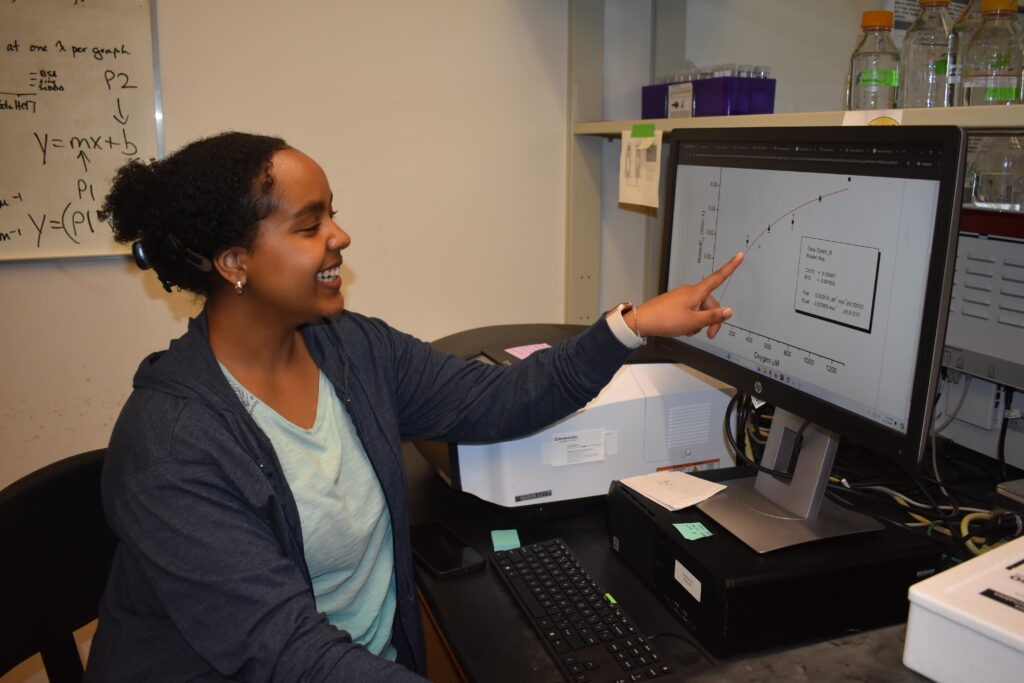
Lignin, a complex polymer in plant cell walls, is a promising biofuel source due to its abundance and energy-rich structure. Efficiently breaking it down could convert lignin into valuable biofuels, reducing reliance on fossil fuels and promoting sustainability. Dioxygenase enzymes, crucial for breaking down catecholic rings in plant woody tissue, play a key role in natural processes like antibiotic production and plant material degradation, making them vital for advancing biofuel technology and environmental sustainability. The “Big Why” for my summer research is to characterize and understand dioxygenase enzymes. By studying these enzymes, we can improve the efficiency of breaking down lignin. The “little why” of my summer project was to understand the relative contributions of enzymatic and non-enzymatic processes to product formation using extradiol dioxygenase chemistry. By reacting the enzymes with various substrate analogs like L-DOPA, dopamines, and DHHCAs, and determining their steady-state kinetics, I aimed to characterize these reactions. This involved measuring key parameters such as , , and to assess the efficiency and specificity of the enzyme with different substrates. This detailed characterization supports the larger goal of efficiently breaking down lignin for biofuel production.
What has summer research taught you about yourself and the field that you researched and/or studied?
This summer taught me the importance of collaboration and the value of diverse perspectives. Working with Saja and Joe, despite being their mentor, I gained valuable insights from their unique knowledge and experiences. This experience enhanced my personal growth and teamwork skills. This summer taught me to be flexible and patient when working with living enzymes and rapidly degrading substrates and products. I learned the importance of adapting to unexpected challenges, taking meticulous notes, and asking better questions to refine experiments and improve data quality.
What advice would you give to students considering a future research opportunity similar to the one you participated in?
Embrace flexibility and patience, as research often involves unexpected challenges. Collaborate openly with teammates, as everyone has valuable insights. Take meticulous notes and stay organized. Most importantly, be curious and enjoy the learning process.