Uncovering The Role of The Active-Site Tyrosine in L-DOPA 2,3-Dioxygenase Through Kinetic Models with Varying Substrates
John Cohen ’25, Or-El Ankori ’25, Molly Durney’24
Faculty Advisor: Dr. Colabroy
What is the broader impact of your summer research? That is, why should the world care about your work?
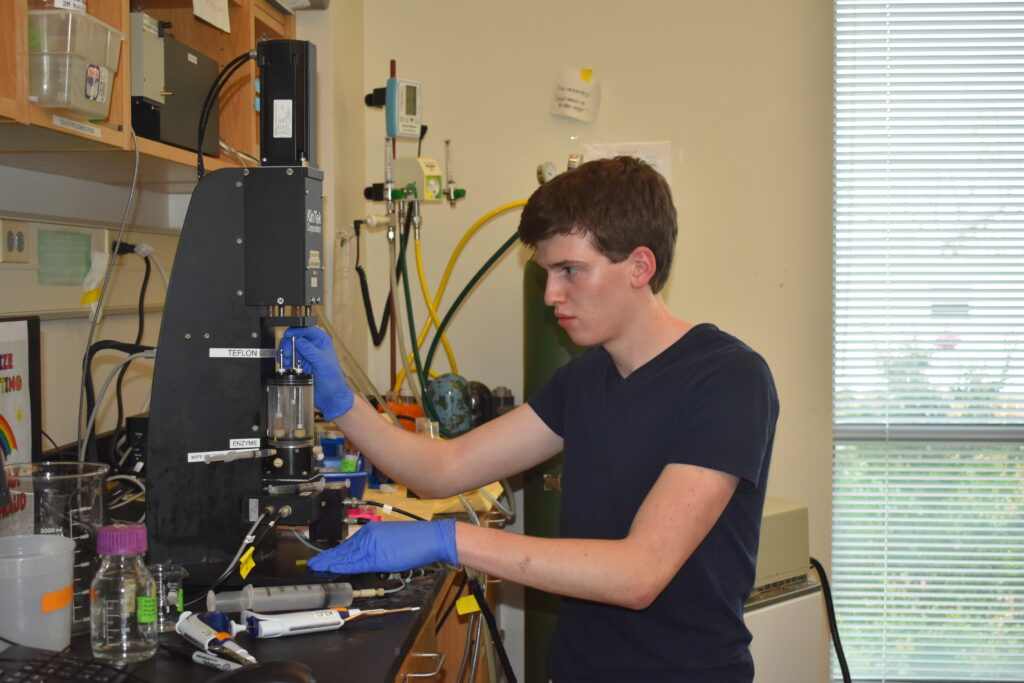
Lignin is an untapped source of carbon that can be valorized into natural products, feedstocks, and biofuels. L-DOPA 2,3-dioxygenase enzymes, which are found in natural product biosynthetic pathways, cleave and oxidize the aromatic bond adjacent to the two hydroxyl groups of catecholic monomer units common to lignin, producing desirable synthons. We ultimately want to create L-DOPA 2,3-dioxygenases that are more efficiently catalytic on a variety of substrates. The recently discovered L-DOPA 2,3-dioxygenase from Streptomyces hygroscopicus jingganensis – JING – demonstrates greater kinetic flexibility and catalytic potential compared to previously studied L-DOPA 2,3-dioxygenases. However, JING proceeds through a different mechanism than other L-DOPA 2,3-dioxygenases. I am modeling JING’s reaction with various substrates and elucidating the role of a conserved active site tyrosine.
What has summer research taught you about yourself and the field that you researched and/or studied?
I always strive for perfection. Research has taught me imperfect is okay. That does not mean that I shouldn’t do my best, but that my best may not be perfect. However, the data is the data, and I must work with what I get. I really developed trouble shooting and critical thinking skills. I also learned how to model kinetic data, a valuable skill in chemistry.
What advice would you give to students considering a future research opportunity similar to the one you participated in?
There are many days where you will leave the lab with no data or a feeling of defeat. It’s okay. Every “failure” has opportunities for learning and growth. Look for the small successes (“wins”) in each failure.